Games & simulation · 2 min read
Mathematical Game Lab
I built three games around one idea: make the mathematics visible enough that a player can inspect a decision, not merely watch an animation. Signal Ghosts explores uncertainty, Chrono Loom explores time constraints, and Geometry Predators explores boundaries and movement.
- My role
- Personal project
- Project scope
- Three offline desktop prototypes · private source
 Open full image in a new tab
Three problems, three independent games
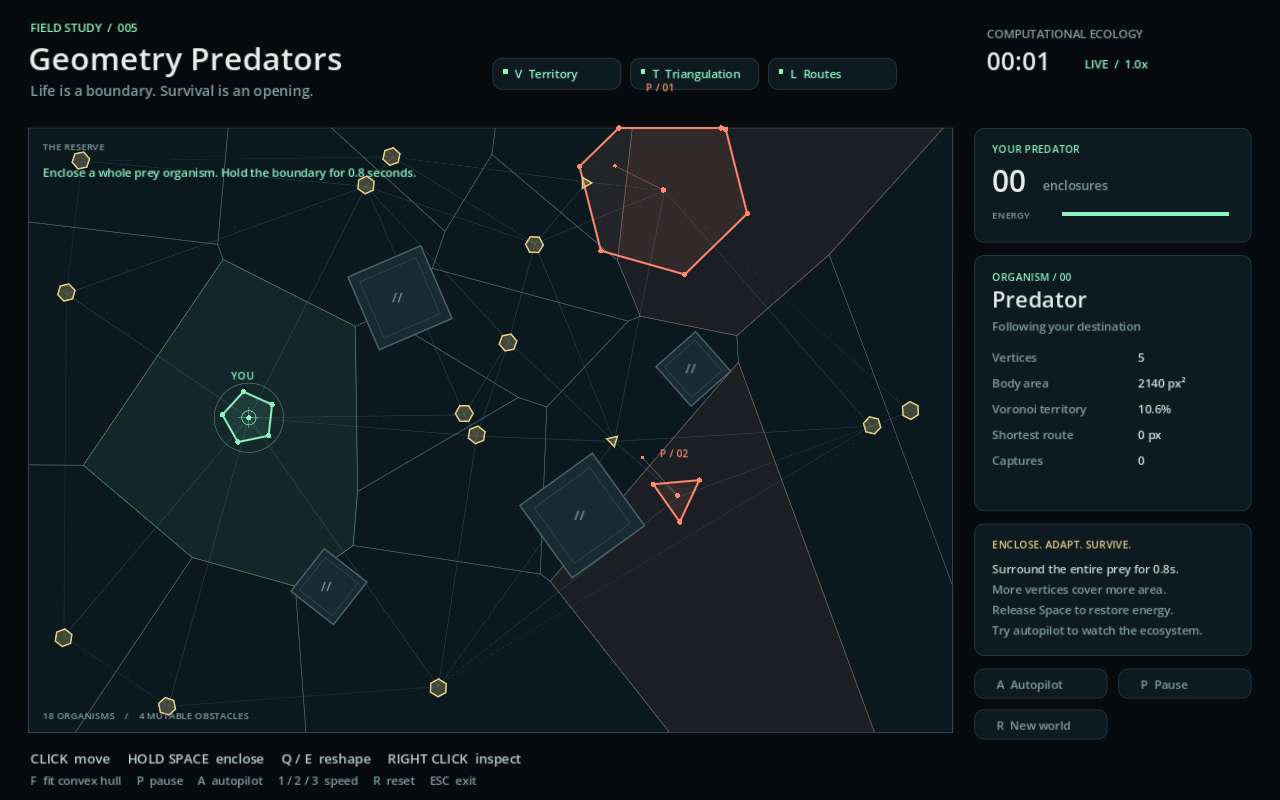
Signal Ghosts asks an agent to act on uncertain observations. It estimates positions from noisy sound rather than reading the hidden world directly. Chrono Loom asks the player to schedule movement and cooperate with earlier versions of a route. Geometry Predators turns polygon containment and navigation into the rules of an ecosystem.
Each game has its own project and interaction model. They share an interest in inspectable simulation rather than a common network service or account system. This separation also makes it easier to explain what each experiment does and where its model stops.
Let the player inspect the mechanism
The games expose probability layers, timelines, territory overlays, paths, and diagnostic panels. Those views are part of the design: an unexpected result should be something the player can investigate.
For example, a crossing in a time projection does not necessarily mean two agents collided in space. Similarly, two polygons touching does not satisfy a full-containment capture rule. The interface makes those distinctions visible instead of hiding them behind an unexplained score.
Keep the rules separate from presentation
The C# games separate simulation logic from Godot rendering, while Geometry Predators shares its geometry routines with headless checks. The repositories contain checks for beliefs, interpolation, collision behavior, containment, and navigation.
These are educational prototypes with deliberately simplified models. They are not scientific simulators or evidence of production game scale. Their value in this portfolio is the implementation of specific algorithms, a readable model, and a way to explore the result.
Project notes
Offline prototypes; no accounts or network service. Source and executables remain private.